

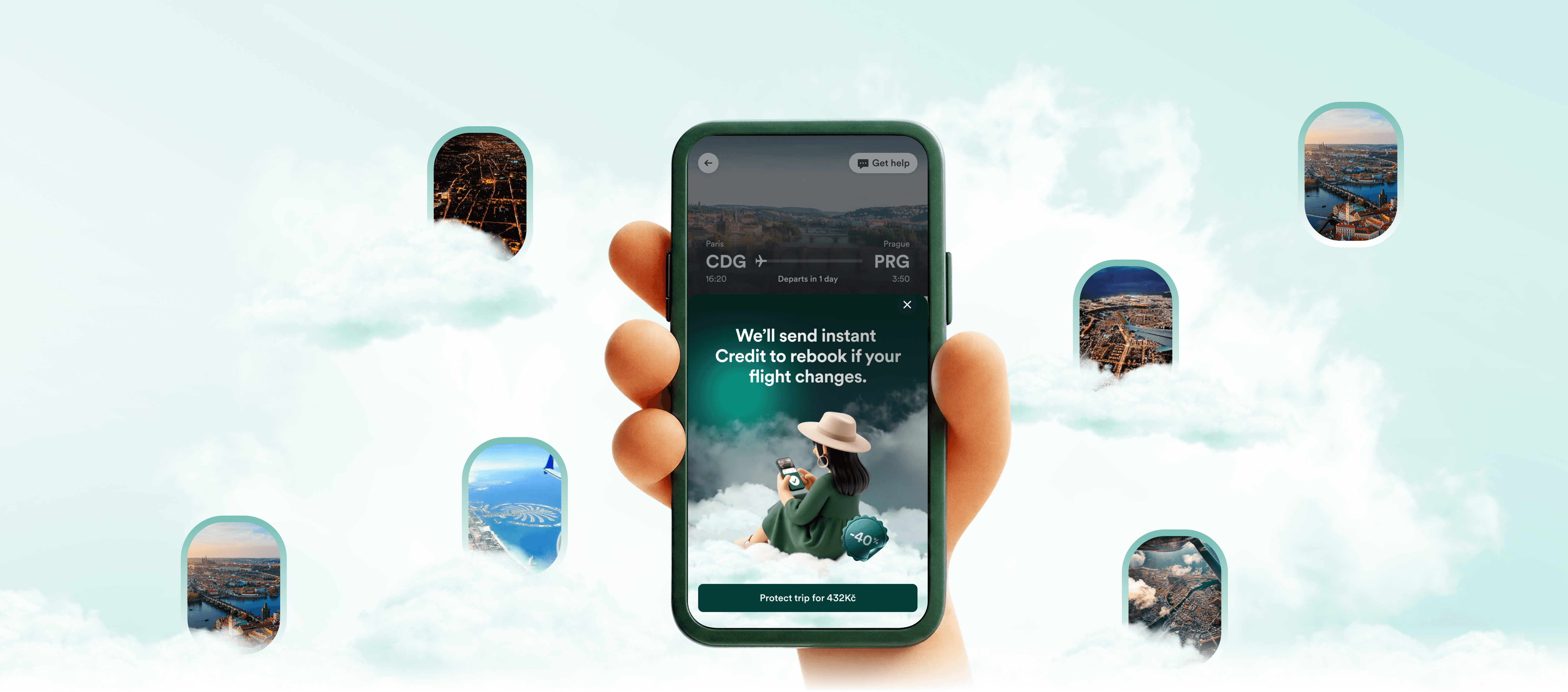
Disruption Protection became Kiwi.com's second most sold ancillary. Over a year of iterative design, testing, and positioning work across booking and post-booking, we doubled the attachment rate of a product that protects customers when airlines don't.
My Role:
Product Designer
Team
Product Manager
Engineering Lead
FE engineers
Data Analyst
Content Designer
Ux Researcher
Marketing/Creative

Kiwi.com is a travel tech company operating at scale - over 50,000 seats sold daily. Its core technology, Virtual Interlining, combines flights from airlines that don't normally cooperate, unlocking cheaper and more flexible routes for travellers worldwide.
I was the design owner for Disruption Protection across booking and post-booking flows. Working with engineering, product marketing and research, I defined how the product was positioned and communicated, then iterated through user testing and A/B experiments to improve both clarity and conversion. This gave me end-to-end ownership - from how the product was sold at booking to how it delivered on that promise when disruptions actually happened.
1 in 6 Kiwi.com customers faces an unexpected airline disruption. That number fluctuates depending on seasons and world events. Disruption Protection promises those customers a peace of mind and a plan B - alternative routes or refunds, handled by Kiwi.com directly, even when the airlines aren't able to support complex itineraries.
Latest designs
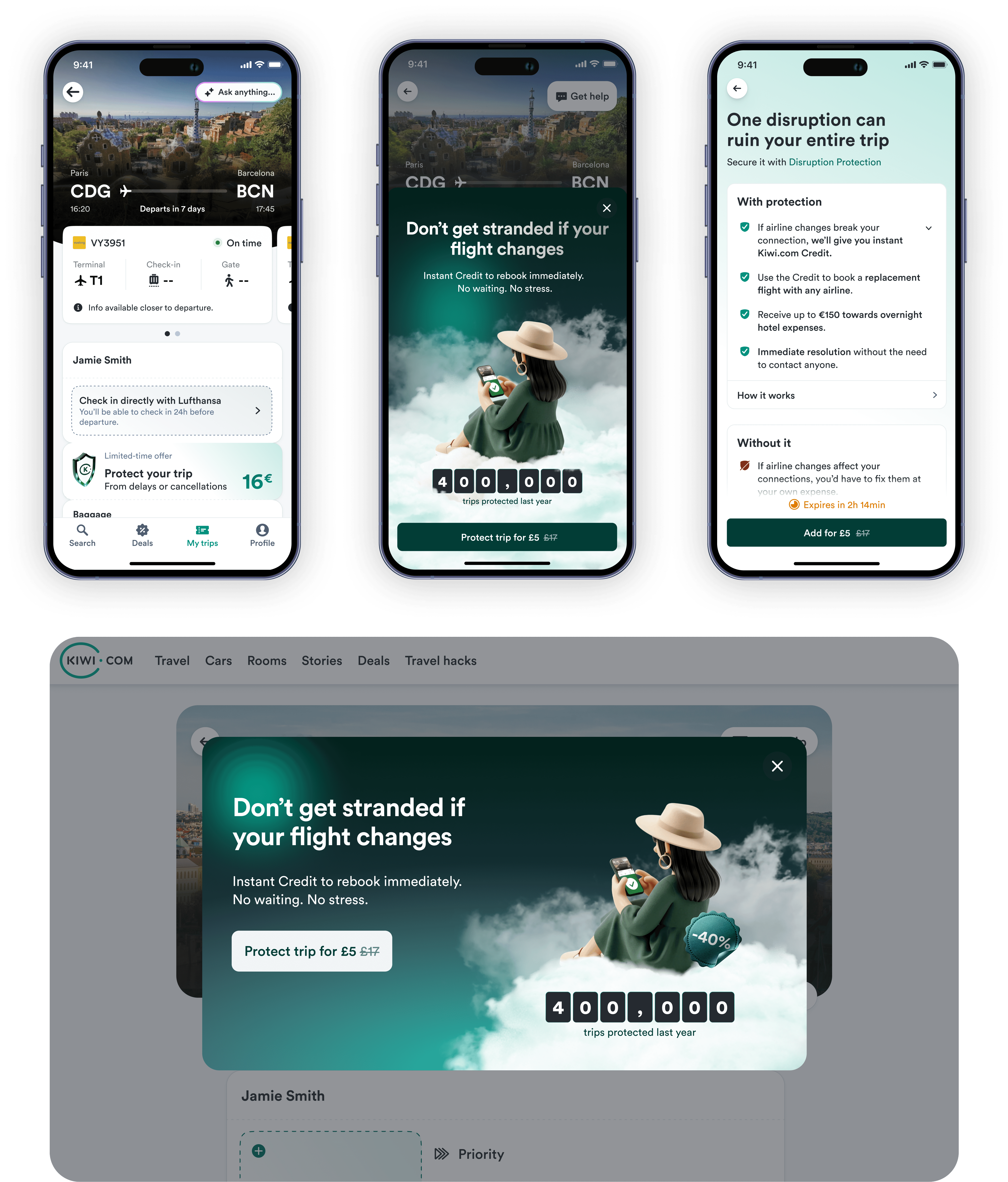
Old designs
Impactful iteration
Data showed that customers who skipped Disruption Protection at booking rarely returned to add it - even though disruption risk peaks in the days before travel.
We hypothesised that a well-timed, contextual prompt could reach users when the stakes felt real.
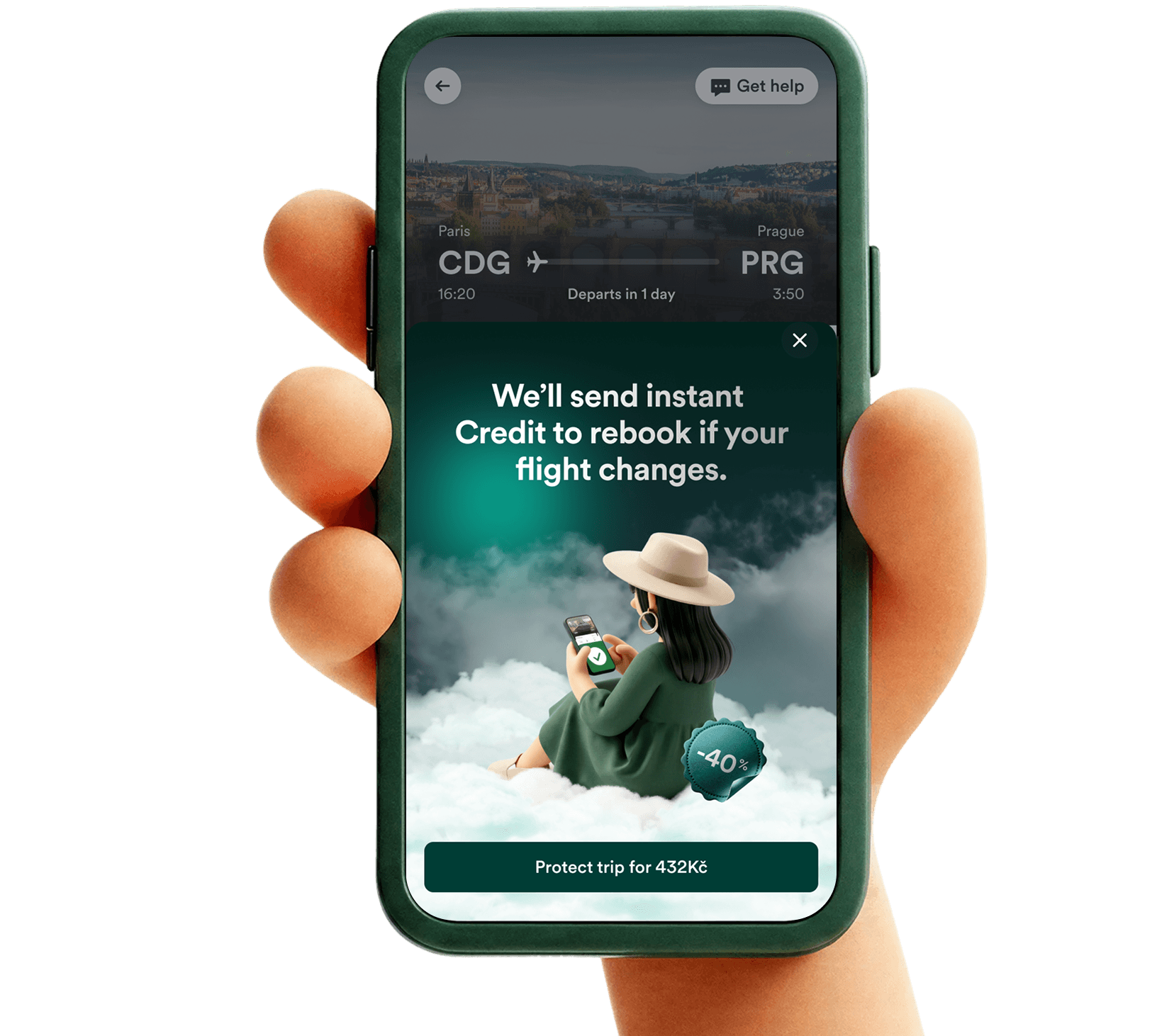
With multiple iterations and feedback rounds, we introduced a popup in the post-booking trip overview, appearing on first visit between 10 days and 2 hours before departure - close enough to travel that the risk feels tangible, early enough to act. First-visit-only targeting avoided repeat interruption for users who had already dismissed it.
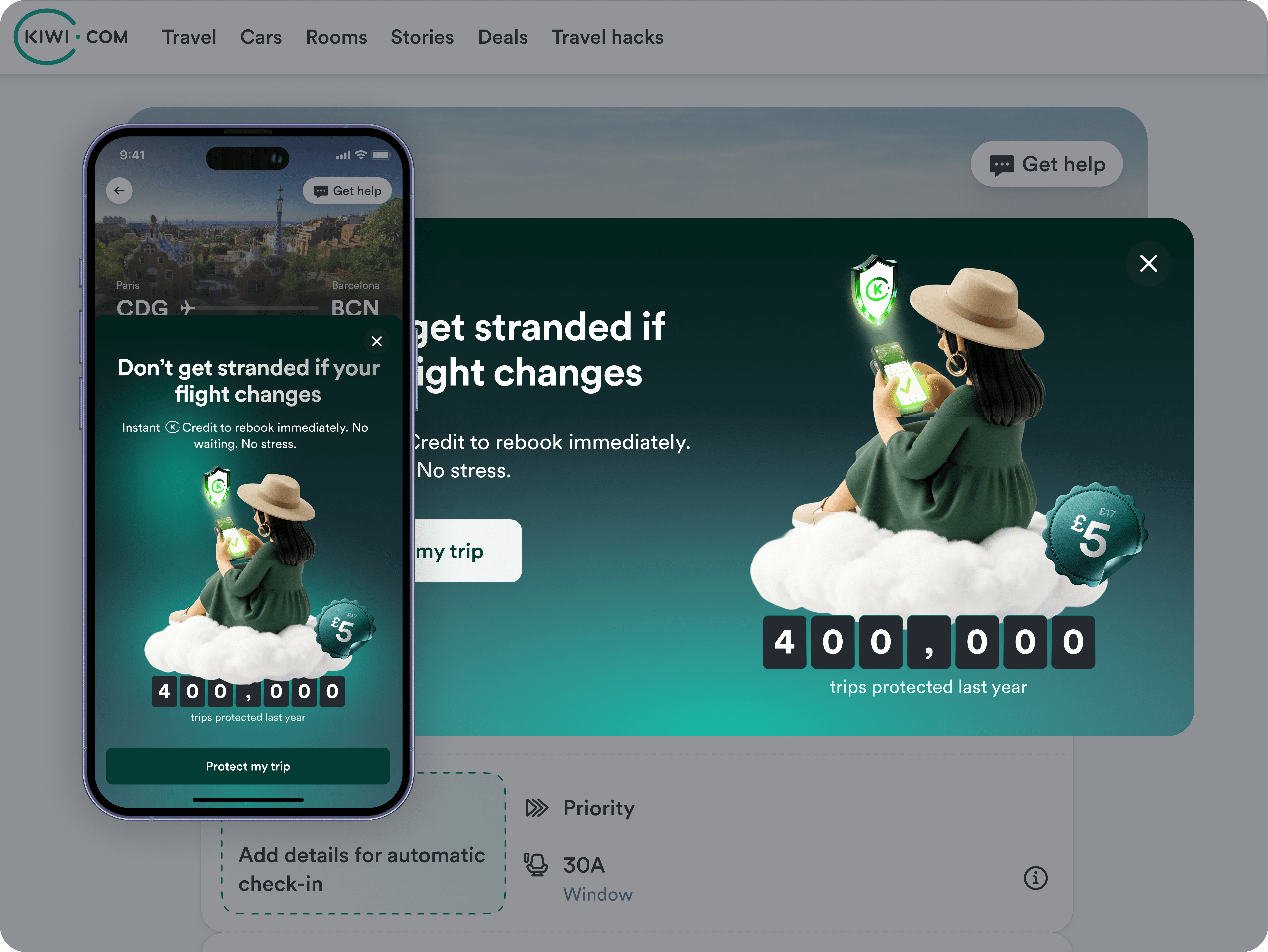
After an A/B tests against the control experience and a couple of iteration. The variant saw roughly 50% more users reaching checkout and around 35% more sales. This translated to 180+ additional sales per day and an estimated 830k EUR annually.
A/B test
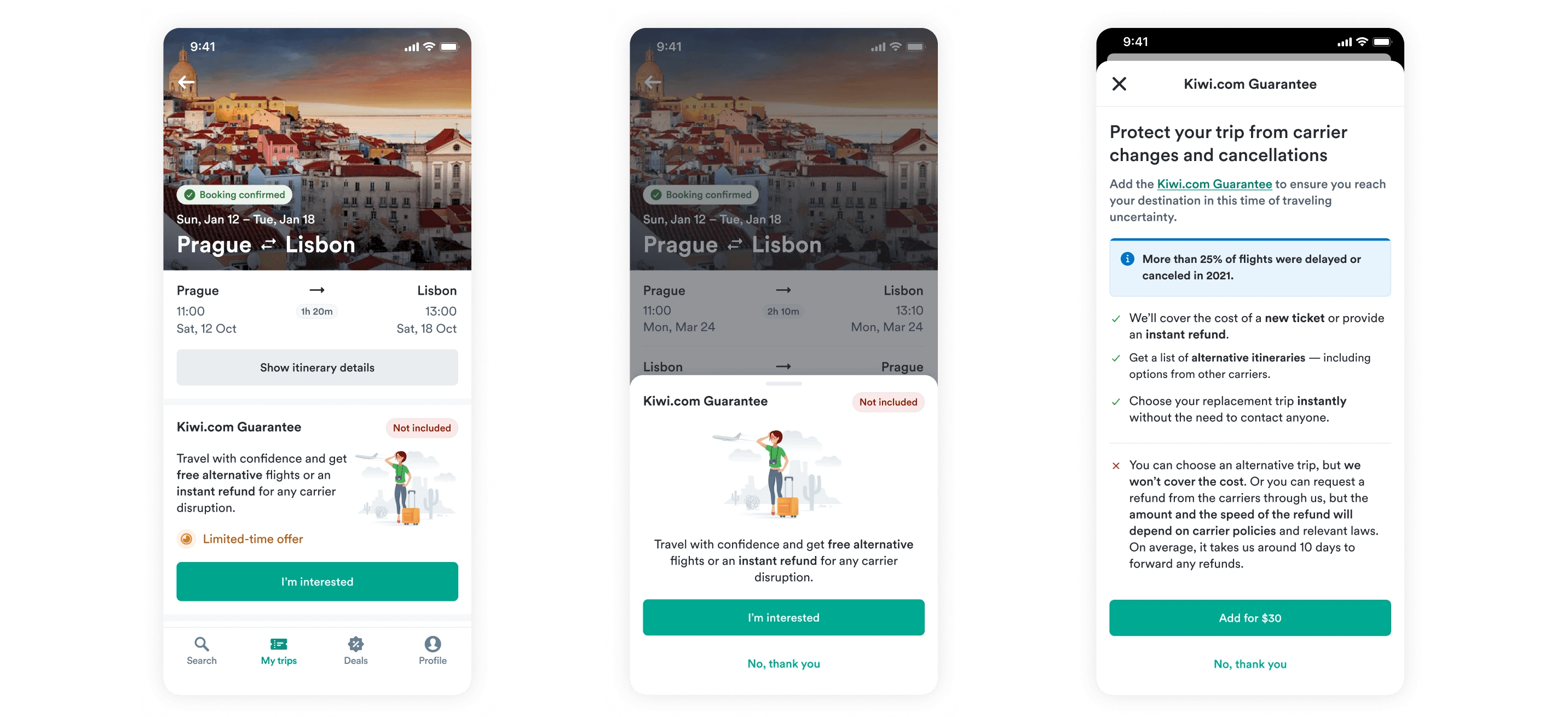
To improve conversion on the Disruption Protection upsell we ran a multivariant A/B test exploring how different calls to action affected user behaviour and revenue. The hypothesis was that the original "I'm Interested" CTA lacked clarity leaving customers uncertain about the purpose, price and next step.
We tested several button variants across modal and banner placements. The final winning variant, "Add For [price]", addressed both problems at once by combining a clear action with upfront price visibility. Disruption Protection attachment rate increased by 19.9% and estimated revenue per booking rose by 48%, from €0.27 to €0.40
My next planned steps included two follow-up tests building on this foundation. First, challenging the winning variant against a more benefit-led CTA, "Protect Trip For [price]", to explore whether framing the action around the outcome rather than the transaction drives further uplift. Second, testing the addition of a reassurance note, "We won't charge you just yet", to see if we can reduce hesitation among customers who may want to explore the product details before committing, without feeling locked into a purchase.
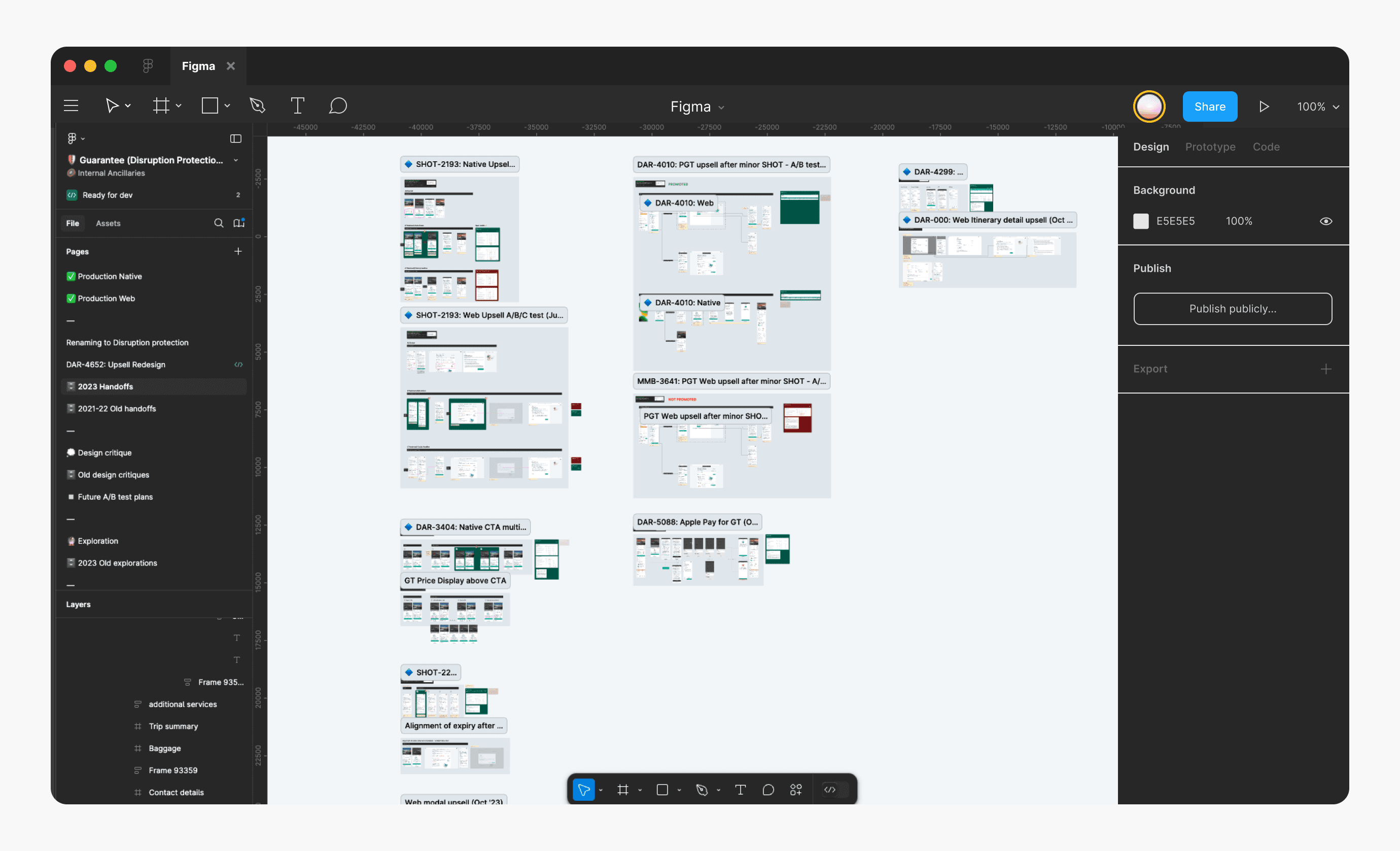
A snapshot of the A/B tests run across this project - covering content variations, pricing optimisation, Apple Pay integration, and product positioning.
List of various A/B tests condusted tracked in Figma file
We tested two new headline variants against the existing control across the banner and modal placements in Trip overview. A data-driven title using concrete statistics outperformed both the control and a catchier marketing-focused, more emotive alternative, suggesting customers respond better to factual, specific messaging when evaluating disruption coverage.
We introduced a Disruption Protection upsell banner within the itinerary detail screen, a placement previously untapped for post-purchase promotion (although the most visited sub-page in post-booking). Released on Android first, the banner converted well among engaged users, with over half of those who visited the product page proceeding to click buy, generating 85 purchases and €2,727 in sales.
Rolled back
We tested triggering a Disruption Protection upsell automatically a few seconds after a minor schedule change was resolved, hypothesising that a recent disruption would make the product feel especially relevant. The tested variant did not perform strongly enough to justify the placement and was rolled back, suggesting customers who have just experienced a minor change may not be in the right mindset to consider an additional purchase.
Currently, there are a couple of tests on the near roadmap.
- Introducing a discount closer to departure - when the trip feels real and the stakes are higher.
- Testing different price points for different tiers of the product to see what actually converts.
And more…
Disruption Protection remains an area of active development. There is always room to improve, and we maintain a running backlog of ideas that we regularly review with UX research and data teams to prioritise and validate what to tackle next.
Designed by Kat • 2026